Traveling Internationally with Your Dog
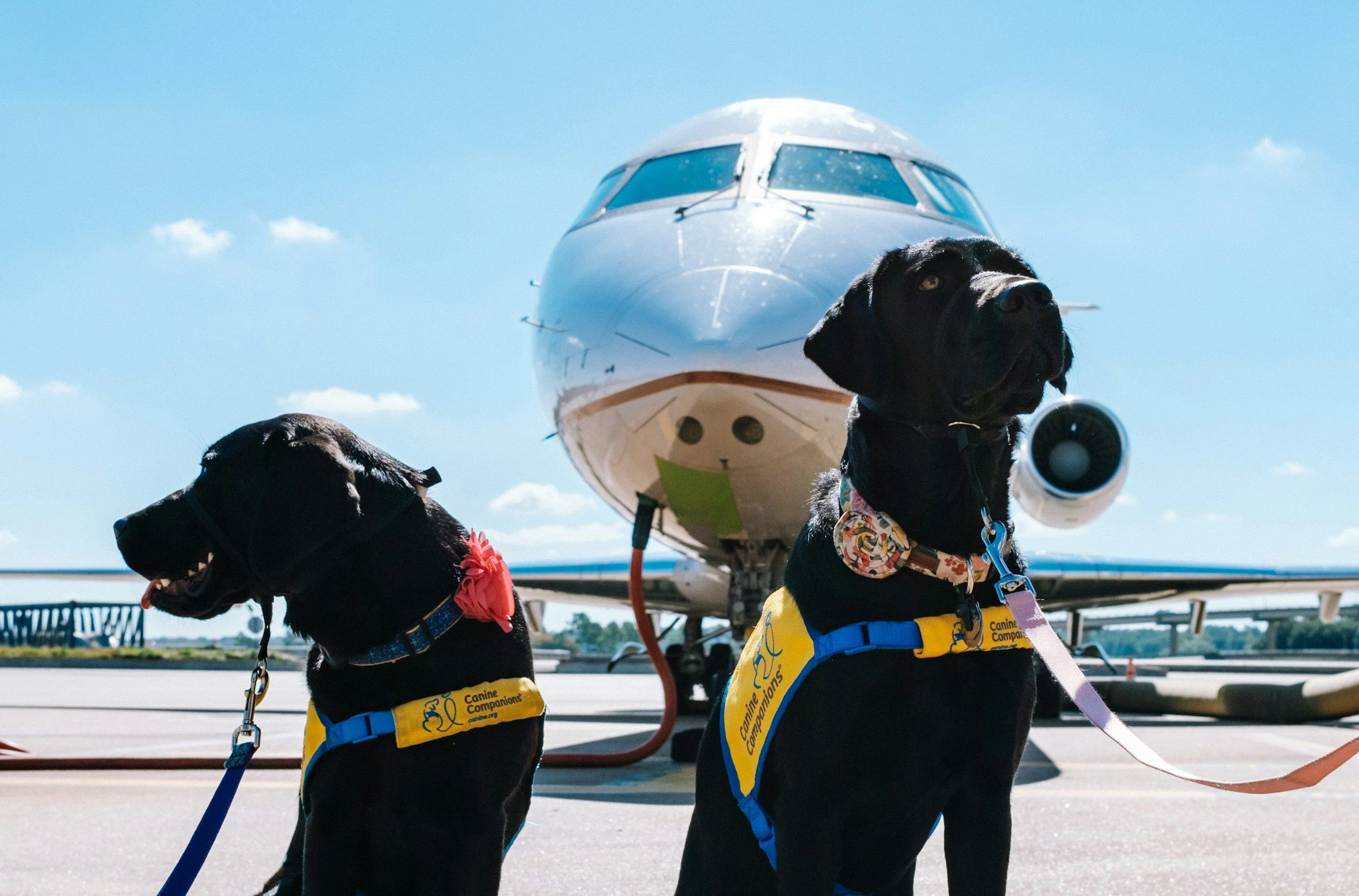
Many of us daydream about surfing in the Bahamas, exploring Tokyo, or climbing Mt. Kilimanjaro, and want to be able to bring our pups along for the adventure! However, as you can imagine, international travel with pets can be costly, time-consuming, and potentially very involved.
While some trips are better off pet-free, with your pups safe and sound at Grandma’s or doggy daycare, we also understand the desire to bring them along for certain trips and occasions.
As avid pet lovers, we know that our furry babies are part of the family and can add to the magic of a vacation. Today we’re laying out the options and some basic guidelines on how to navigate international travel with your pup!
Travel Options
Bringing your pup on a plane with you:
This is our number one recommended way to travel overseas with your pup. Your dog will be in a carrier on their journey, and must be able to fit underneath the seat in front of you (where your purse/backpack/briefcase might usually go).
This option means to forego a personal item on your journey, so make sure to pack necessities like medications, snacks, and your in-flight entertainment in your carry-on bag instead.
This option is only for pups that can fit underneath the seat in front of you. Unfortunately, if you have a medium-to-large breed dog, you will have to choose another method.
You may want to inquire with your pup’s veterinary team about getting an anxiety and/or motion sickness prescription medication before your date of travel. This can help both you, your pup, and other passengers have a stress-free flight, free from any whining, whimpering, or accidents.
The carrier must be a TSA-approved soft carrier; hard carriers will not fit underneath the seat in front of you. Check out our carrier recommendation here. Make sure to always check your airline’s restrictions, regulations, and rules before purchasing a carrier.
Flying with your dog as cargo:
This option is considerably more expensive and unfortunately, is required on some airlines for bigger dogs. This option may sound scary or unsafe for your dog, and not all airlines are the same, so ensure that the cabin where your dog will be is pressurized and held at a comfortable temperature.
It is a common concern that pets in carriers flying as cargo are neglected for the flight. Airlines all differ in terms of standard of care - to prevent your pup from being uncomfortable it’s paramount that you do your due diligence as a pet owner by researching how the airline you choose will accommodate your pup while flying as cargo. Some airlines hold themselves to strict, high standards of care while others do not. While you (and the airline) cannot prevent separation anxiety, there are many other ways that airlines can keep pets safe and comfortable, such as with climate control, tracking, and loading priority.
Do your research, and do not be afraid to contact the airline directly to ask questions. Some great questions to ask are: “Is the cargo space pressurized?” “Is it temperature controlled?” “Will someone stay with them during the loading process?” “In what order will they be loaded amidst other cargo?” “Is there a pet relief area near the terminal?” and/or “Will someone notify me if my pet is in distress?”
If your dog tends to be anxious, or is not used to travel via airplane, talk to their veterinary care team about anti-anxiety medication for the trip. This can be the difference between a long and unsettling journey, versus a long and restful nap.
A sincere warning: flying as cargo can be dangerous and scary for pets. If at all possible, avoid flying your pet as cargo. Flying as cargo can pose threats to their safety and well-being due to unregulated pressure and temperature, noise pollution, turbulence, as well as mistreatment during handling. Read “The Dangers of Flying Cargo” below for more information on these safety concerns.
Having your pet shipped through a licensed commercial shipper:
Pet shipping is very common for those who are moving internationally, but may also be required for travel with dogs that are larger than 100 pounds, including the weight of the carrier. This option is the most expensive out of the three options listed; however, it can take a lot of stress and planning off your plate, which is why many pet parents choose this option.
Large companies like Airpets International or Happy Tails Travel act as “Known Shippers” who can book cargo, ensure safety, and manage customs clearance. These companies are well known and trusted; while they are known to be very costly, pet parents agree that it is worth the price to be able to travel stress-free, knowing their pup is in capable, loving care while reaching their destination.
For this option, you will need to provide a valid Certificate of Veterinary Inspection (CVI) or "health certificate" issued by a USDA-accredited veterinarian within 10 days of transport and an up-to-date rabies vaccination certificate and proof of any destination-required microchips.
Guidelines
Find a US Department of Agriculture-certified veterinarian:
Before your pup is able to take off, or even enter the airport, they will need to have their health checked by a government-approved vet. The price of this health check may depend on the number of laboratory tests your dog needs, plus the cost of sending it to the government to be officially filed. Additional tests depend on your country of travel; certain countries are very cautious about certain diseases/infections entering the country (such as Norway, Finland, and the UK with tapeworms). To find a USDA-certified vet, check out their website here.
Ensure that your pup is up-to-date on all of their vaccines and has a rabies vaccine certificate. It is also best practice to inform your pup’s veterinary team of your travels, including where you are going and how long you will be there. Various countries contain viruses and diseases that are different from the United States, and your veterinary team can help you be aware and prepared for dealing with the possibility of coming in contact with them. Being transparent with your pup’s vet can also be helpful in knowing if your pup will be able to withstand the stress and sudden change of traveling. Your vet can advise for or against travel, can offer tips to help them through travel, and may prescribe them with anti-anxiety and/or motion sickness medication.
Make sure they are microchipped & have a tracking device:
In the unfortunate event that your pup escapes or gets lost during travel, a microchip can be their savior. Many veterinary offices, rescues, and shelters (even around the world in various countries) can scan and identify your pup through their ISO microchip. If your pup is not already microchipped, ensure to schedule an appointment with your veterinary office to get your pup set up with it, and do not forget to activate the chip online.
Also consider investing in a GPS tracking collar or device that can be worn by your pup. You can track your pup in real time, make sure they are safe, and find them if they wander off. Our recommendation is the Fi GPS Tracking Collar. To use the Fi collar, you must download the Fi app on your phone. The app allows you to track your pup in real time, get escape alerts, track your dog’s exercise, and monitor their health. It is also waterproof, which can come in handy if your vacation will be including beach, lake, or poolside fun!
Avoid layovers as much as possible:
If your dog is flying as cargo, or being shipped, a layover can add to their stress and disorientation during travel. A layover can also extend the amount of time your pup is without a potty break, especially if they are flying as cargo. Flying direct is the best option in this scenario to reduce the amount of time your dog spends inside their carrier. If a layover is necessary, choose the shortest layover possible to reconnect with your canine companion as soon as possible. This is less necessary if you’re flying with your pup as a carry-on, as many airports have doggy-relief areas in the terminals. Check out the layout of the airports you are departing and laying over from online before your travel dates to check that this is an option before booking!
Check your airline’s website to ensure you purchase the correct carrier:
Their crate is where your dog will be settled for hours. Finding a crate that has the appropriate amount of space for their body length, which is usually enough room to turn around, will provide them as much room as possible in a new and potentially startling environment. If your dog is traveling as cargo, a hard-sided carrier is necessary to keep them safe and is usually required by airlines. Our biggest tip for purchasing hard-carriers is to pick one with airflow vents around the carrier to maximize your dog’s comfort and temperature control.
If you are flying with your small dog as your personal item (in the cabin with you), ensure that your carrier is TSA/airline approved. When flying in-cabin with you, the carrier must be a soft-carrier in order to comfortably fit under the seat in front of you. For more information on approved carriers, be sure to check your airline’s rules and regulations on their website before purchasing. For in-cabin travel, our carrier recommendation can be found here.
Label their crate:
For the dogs traveling as cargo or being shipped, the crate that they’ll be transported in should include as much identifying information as possible somewhere on and within their crate. Their name, your name, your contact information, and your pup’s flight information should all be readily included on and/or within their crate. The more information there is, the easier it will be for you two to reconnect. You can do this multiple ways, and we suggest using ALL methods in case one method is accidentally torn off during travel. You can attach luggage tags to the crate through airflow vents and on the front opening. You can also use masking tape and permanent marker and/or index cards taped down with clear heavy-duty packing tape to get all of their emergency information onto their crate. Ensure you label their emergency information with your name, their name, your phone number (and a secondary phone number), your email, any medical concerns your pup has, and any other identifying information you are comfortable labeling.
Consult a government agency website for detailed information:
These tips provide a general idea of the sort of tasks required for international pet travel, but a government website should be consulted multiple times throughout the process to ensure you’re up-to-date with the latest laws and regulations. The last thing you want is to spend time, money, and energy preparing for your trip, just for your pup to be denied because you may have missed an important law or regulation.
The Dangers of Flying as Cargo
In recent years, dogs flying in their crate as cargo has come a long way in terms of safety, regulation, and standards of care for pups traveling with their families. However, there are still major risks and dangers associated with flying as cargo that need to be explicitly shared in order for you to make a sound decision about how your pup will be traveling. Our general advice is to avoid flying your pup as cargo whenever possible. When they are flying as cargo, you are separated and no longer able to advocate for their comfort and safety. Some risk factors include:
Fluctuating temperatures:
In most aircrafts, temperatures of the cargo hold are not/cannot be regulated, and thus fluctuate widely. This is typically because aircraft cargo holds are created with one thing in mind: to hold luggage and cargo. While traveling with pets is more common than ever, aircraft designs have yet to accommodate our pets with temperature regulation in that area of the plane. These fluctuating temperatures can cause severe dehydration, overheating and/or heat stroke, and even death.
Fluctuating Air Pressure:
Just like temperature, air pressure fluctuations cannot be regulated in cargo. Even when flying on board, the sudden changes in air pressure can be noticeable, and these changes in air pressure are even more exaggerated in the cargo hold. For us, we may feel it as a “pop” in our ear, or sudden nausea. For our pups in cargo, it can make them extremely nauseous and/or anxious, causing them to vomit, pee, or poop in their crate.
Noise Pollution:
As we know, dogs have better hearing ability than we humans do. They can hear even the smallest sounds from a distance (such as a single chip falling onto the floor while they are asleep in another room). The cargo area of a plane can be filled with loud, ongoing, and ear-wretching sounds such as the aircraft engine blowing, and luggage or cargo crashing around and banging up against their crate. This ongoing noise pollution can cause extreme amounts of anxiety and stress for your pup.
Turbulence:
As we all know, especially if you are an avid flyer, turbulence is a common occurrence while onboard a plane, and is something that the pilot cannot always avoid. That same “drop” in your stomach you feel when turbulence occurs will happen to your pup in cargo as well. The uneasy and stressed-out feeling you get, your pup gets times ten. As humans we are able to understand and rationalize these feelings as we know that it is a normal and common occurrence, and will end at some point. Our pups are not able to understand and rationalize this experience, which causes them extreme stress. In cargo, you are not there to comfort them, speak to them, pet them, or help them in any way through it, which can be extremely difficult for your pup and may cause long-term stress or aversion to traveling.
Handling:
While the first four dangers of flying your pet in cargo are extremely troubling, the handling of your pet seems to actually be one of the biggest risks in the flying process. While many airlines have come a very long way in terms of expectations, regulations, and policies regarding handling pets as cargo, there are still so many horror stories about the mistreatment and mishandling of pet crates amongst a multitude of airlines. Human mishandling and mistreatment of pet crates has been a widely reported issue as many of these cargo handlers are unfortunately not always caring, careful, or intentional about how they are handling cargo (including pet crates).
The scariest part of this is that after you hand your pet off to the airline, you cannot see or know how they or their crate are being handled. It is policy for cargo handlers to stow pet crates last so that they are not left out in sweltering heat, however, this policy is not always strictly adhered too. Likewise, some airlines may offer or promise to feed, give water to, or take your pet potty, however, as pet owners we have no way of knowing whether they will actually follow through with this. It is the unfortunate truth that any damage done to your pet or to their crate will be unknown by you, and any negative outcomes will not be realized until it is far too late.
In Summary

Whether you’re a first-time flyer or an expert traveler, traveling with your dog can add an extra layer of stress to the journey. Although the process can be time-consuming, the right amount of planning, paperwork, and preparation will ensure that you and your pup are able to explore the streets of Tokyo, Sydney, or Rome together! Our biggest tip when traveling with your pup internationally is to be overly prepared! Regardless of what travel method you choose for your pup, make sure you take the time to go through ALL the rules, regulations, and expectations. Ensure that your pup has their health certificates, is up to date on vaccines, and has the correct carrier for their travel method. Talk to your pup’s veterinary team about your travel plans and ensure your pup is capable of taking on the stress and change of environment; ask about getting a prescription for anxiety and/or motion sickness. In summary, when it comes to traveling with your pet, you can NEVER be too prepared. Happy travels!
*This article may contain affiliate links
Written & Edited by: Jessica Hays & Dog Tired Adventures Team
Lead Dog Walker/Social Media & Community Outreach Associate
Sources
https://www.aphis.usda.gov/pet-travel/us-to-another-country-export/pet-travel-guidance-pets-traveling-another-country-united
https://www.aphis.usda.gov/pet-travel/us-to-foreign-country/cost-to-endorse
https://www.ipata.org/ipata-pet-shippers-air-and-ground
https://www.youtube.com/watch?v=bWluZN_zJv0
https://www.pettravel.com/0001216.cfm#:~:text=Flying%20with%20a%20Dog%20or%20Cat%20in%20the%20Cargo%20Hold&text=The%20cost%20can%20run%20from,when%20accompanied%20by%20a%20passenger.
https://www.aphis.usda.gov/pet-travel/accredited-veterinarians/endorsement-offices
https://airpetsinternational.com/
https://bluecollarpettransport.com/the-top-dangers-of-putting-pets-in-airplane-cargo/